No Infrastructure Needed: Ad-hoc Networks, MANET and J.Fi
What an ad-hoc network is, why MANET is harder, and how J.Fi's upcoming MANET mode handles it
Any wireless network has to solve one basic problem: how two nodes can talk when they are out of each other’s range. A node here is one unit of communication — a handheld radio, or the radio module on a drone. LTE and WiFi solve it with infrastructure: cell towers and WiFi routers relay the data. That works wherever the infrastructure exists. The question is what to do where it does not.
Ad-hoc networks
An ad-hoc network answers that question without infrastructure. Nodes in range talk to each other directly, the way two iPhones exchange photos over AirDrop. When a node cannot reach its destination, a neighbor relays the data for it — the nodes themselves become the infrastructure.
There are two main ways to relay.
| Method | How it works |
|---|---|
| Routing | Each node works out the best relay path to the destination, then sends the data along it |
| Flooding | Every node acts as a relay, so no node needs to know how the others are connected |
MANET
A MANET (Mobile Ad-hoc Network) is an ad-hoc network whose nodes move, so the connections between them keep changing. Routing then has to keep tracking those connections, and the tracking messages take up channel time that data could have used.
Flooding needs no tracking at all, which is its appeal in a MANET. The catch is that every node relays everything, so the shared radio channel fills up with copies of the same message.
J.Fi MANET mode
J.Fi will soon have a MANET mode. It uses managed flooding: flooding in which only some of the nodes relay. Like plain flooding, it needs no tracking of connections.
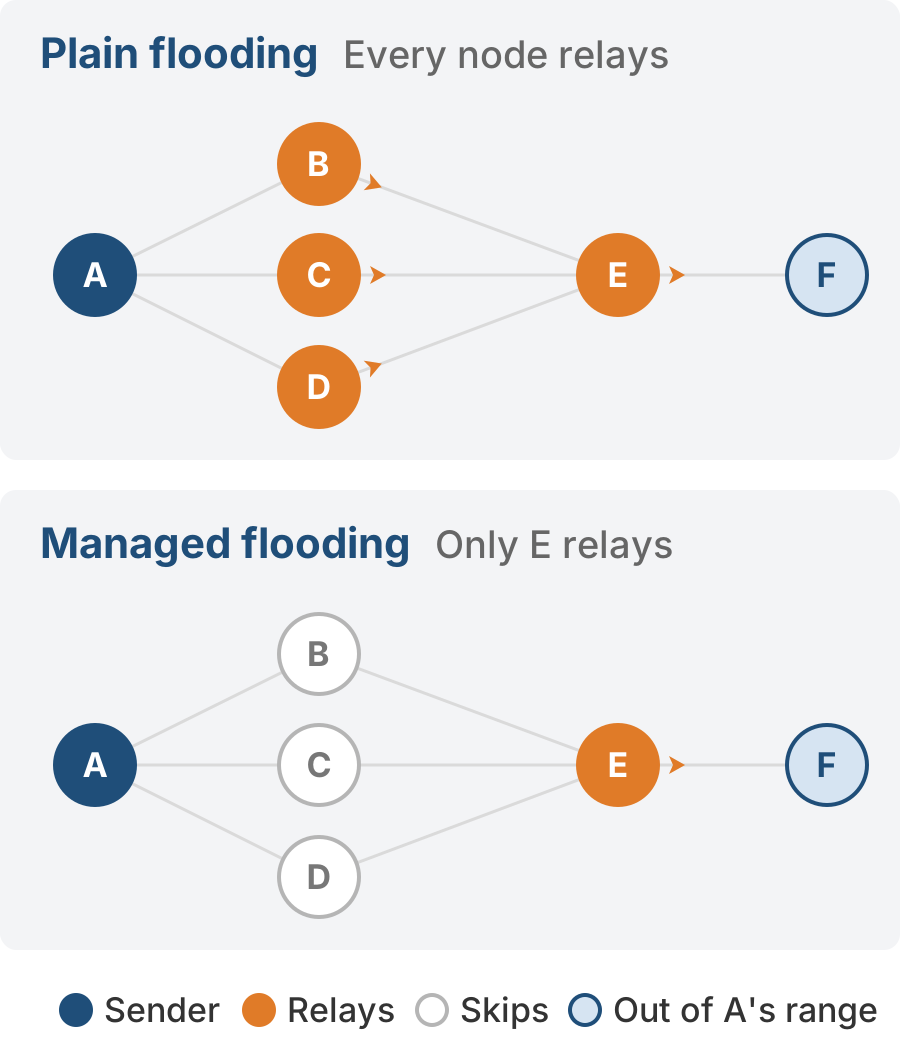
- Delivery carries on as nodes move. If a node moves away or drops out, another takes over the relaying at once.
- Holds up in dense swarms. However many nodes are nearby, only a few relay each message, so the channel doesn’t clog.
- No pairing. A J.Fi joins the network as soon as it is turned on.
- Fixed relays. An always-relaying node, such as a drone over a ridge, can link two groups.
Get in touch
For questions about J.Fi or its upcoming MANET mode, contact [email protected].